This message is at the heart of my work and though it's a cliche, it is one I wish to spur on and truly believe in. I once read something like: 'Do what you love, because it's the only thing you will ever have enough motivation to actually get great at.'
Mostrando entradas con la etiqueta Thoughts. Mostrar todas las entradas
3 may 2013
20 feb 2013
23 ene 2013
22 oct 2012
Thoughts on character design
Thoughts on character design:
Somethings I think are important in character design.
This post is about thoughts I have about character desing, not a ‘how to draw’tutorial. Besides knowing how to draw a character, how to use perspective, howto draw expressions, there is also an internal process going on when I design a character. I tried to write down some thoughts about designing characters, and I’d like to share them with you. I hope they can be ofuse for you. If you have comments or additions, please leave a message in the commentssection.
1. Observation
I make a habit of constantly observing people.I found that for me to understand a character, I need a certain understandingof people, how they act, how they convey their emotions, why they wear certainclothes, how they use body language to emphasize or contradict what they aresaying. A man who just got robbed,will walk into a police station completely different than a man who was justcalled his stolen car has just been found. Someone who is genuinly happy foryou will smile at you differentlythan a salesman giving you his smiling talk.
I find it really useful to study actors, andthe way they ‘get to know’ their character. How they use body language, facialexpressions, clothing, make up etc. to define a character. Some actors have really mastered the art of ‘becoming’ a character. They are very much aware of every gesture, howthey move, talk and breathe. It can be really helpful to approach the desing ofa character in a similar way
It is the task of a character designer to usehis knowledge of how people and translate this into a design that is believable.
2. Reading the script
I thoroughly read the script, speak with thewriter in order to get as much information as possible about the character tocreate an idea in your mind tounderstand who this characteris. Designing a character is notjust playing around with shapes; it really is finding and defining the character’spersonality.
When I read the script I focus on: How does the character feel, but alsohow he uses subtext in his expressions; If he’s scared, does he show it, ordoes he hide it, how does he relate to his environment. If he’s big, does hefeel big?
3. Documentation
There is more to the character than just howhe feels. ‘personality’ can be added to the character by how he dresses, how hecombs his hair. If I want the character to be believable and convincing I need to use elements from the world we know, and use and alter them in my design. The choices I make arebased on the script, and from this, I try to be creative, and come up with manydifferent ‘solutions’ for what the character could look like.
Google is a very helpful tool in referencingclothes, and assecoiries, but going out and looking at the real stuff, andmaking sketches on location can be very important as well. When I need to findout what dress a dancer has to wear, it can sometimes be more useful to go to adance club and speak with dancers, and understand what is important for a dancedress, than to randomly combine google images into one dress. Someone who knows all about dance dresses should also be convinced by my design...
I like to combine ‘direct’ documentation withassociative documentation. For instance when I need to design a certain dress, I look for dresses in real life(direct documentation) but also for things I associate with the mood it has to have,or the personality of the character, or something random that comes up when Ithink of the character. (associative documentation.) Combinig these twoelements, often lead to believable, but also creative design.
4. Trial and error
It takes more than one drawing to come up witha final character design. Sketching often is no more than thinking visually. Someideas are good, some are bad, but there’s always room for improvement.
Step 1, 2 and 3 are essential to come up withvarious ideas and concepts. A character designer comes up with many differentideas and approaches to the subject. Allowing myself to try things that don’twork, is essential to eventually come up with great ideas. Nobody likes to showtheir bad drawings, but in order to be creative, it is neccesary to exploremany different directions. I hateit when a drawing or a conceptdoesn’t work, or when I make a bad drawing. The alternative however, is not allowing myself to make anymistakes, wich would mean doing the same thing over and over again...that’s notan option for me.
The great thing in designig a character thisway, is that I ‘get to know’ thecharacter during the process. Whena drawing doesn’t communicate what I want it to, it means it doesn’t portray thecharacter. Trying againdifferently makes me slowly but surely discover who this character actually is.
5. Technique
A lot of books are written on character designtechnique. As I mentioned, I won’t go into ‘how to draw a character’ in this post, but there aresome things to be said about technique.
It is important to constantly keep ondeveloping both my drawing skills, as well as my creative skills, which meansbeing able to come up with creative and original ideas.
Because most characters are based on humancharacters – even when the character is a tree, a donut or a rock, it’sexpression and the way it’ll communicate with as is by human gestures andemotions- it’s important to attend life drawing classes. In these classes Idevelop a better understanding of human anatomy, expressions, shapes, 3dimensionality drawing skills, quick sketching skills and so on…
When drawing from life, making a caricature of what I see is very useful. Certain features of a model stand out, and emphasizing these features is like underlining an important remark in a notebook. I can go through my sketchbook and easily recognise what it is that stood out to me during a specific drawing session, and I can use this information in my character designs.
Within a charachter it’s all about proportions. About the relationship between the sizes of the different body parts, the sizes of the different volumes, textures, colors, etc.
In the end there has to be a relationship beteen all proportions that suits the character. Wether it is balanced , for instance based on the golden ratio, or disbalanced; creating an off-balanced character.
It often helps me to think of contrasts. if a character has curly hair, I can juxtapose this by adding straight elements, for instace a sword, so they complement each other (fuzzy curly hair, soft vs. metal straight). Or a man who is very wise and knows a lot of things, may have a big head, so his body can be small to put emphasis on the head. Using contrasts is a useful tool to be very clear about what you want to express. If all is blue, then red stands out. When I have established that, I can look for the right balance between red and blue. So I first look for the big statements, and then refine them.
jtotheizzoe: The Science of Why Adele’s ‘Someone Like You’...
jtotheizzoe:
The Science of Why Adele’s ‘Someone Like You’...:
jtotheizzoe:
The Science of Why Adele’s ‘Someone Like You’...:

jtotheizzoe:
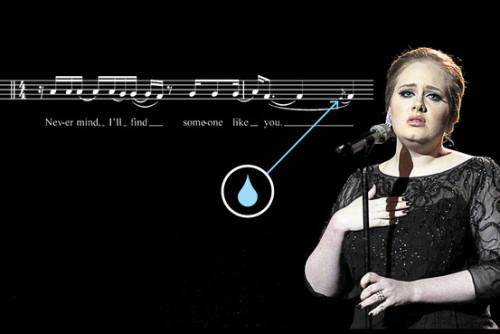
The Science of Why Adele’s ‘Someone Like You’ Makes Everyone Cry
Tension, resolution, and the ever important “buildy-ness” (which is a term I invented but is accurate), these are the characteristics behind the most extreme emotional reactions to songs:
Twenty years ago, the British psychologist John Sloboda conducted a simple experiment. He asked music lovers to identify passages of songs that reliably set off a physical reaction, such as tears or goose bumps. Participants identified 20 tear-triggering passages, and when Dr. Sloboda analyzed their properties, a trend emerged: 18 contained a musical device called an “appoggiatura.”There’s just about the most detailed scientific analysis of a Grammy-winning song ever at the link.
An appoggiatura is a type of ornamental note that clashes with the melody just enough to create a dissonant sound. “This generates tension in the listener,” said Martin Guhn, a psychologist at the University of British Columbia who co-wrote a 2007 study on the subject. “When the notes return to the anticipated melody, the tension resolves, and it feels good.”
Chills often descend on listeners at these moments of resolution. When several appoggiaturas occur next to each other in a melody, it generates a cycle of tension and release. This provokes an even stronger reaction, and that is when the tears start to flow.
(via WSJ.com)
Make Mistakes!
Make Mistakes!:
Michael Jordan: "I failed ovrer and over and over again in my life....and that is why I succeed."
When I saw this commercial many many years ago it stuck with me! It opened my eyes to the idea that you really have to try and try and try and continue to strive for your goals. No matter where we are in your career we will always make mistakes and we shouldn't be afraid of them. Whether you're animating, storyboarding, gesture sketching, etc...
The major key to mistakes is having someone in a mentor like role or trusted friend noticing the problem and helping you correct them. We need to make mistakes and make them as much as possible to eventually create art that we like or reach goals aimed for. Younger artists can get easily discouraged when it comes to making mistakes and feeling like they aren't at the level they'd like to be. I like to tell these artists to save their sketches so that they can reflect back and see how good they've gotten.
The whole idea is to learn and grow and if we are too shy or scared to show mentors (or trusted friends) our work and search for constructive criticism in correcting our mistakes we will stay at the same level we're at.
Glen Keane told a story of how when he entering Disney, he filled up 10 sketch books, 100 pages each in a week. He showed them to Eric Larson who on the average chose 1 in 10 sketches that were good enough to present to the company. The rest is history for Glen as we know it.
The truth of his story was that he didn't have any fear of failing, making mistakes and showing his mentor his work. I'd say Glen is sort of the Michael Jordan of animation wouldn't you?
This is great: ten drawing tips from Gary Panter, including such...
This is great: ten drawing tips from Gary Panter, including such...: 
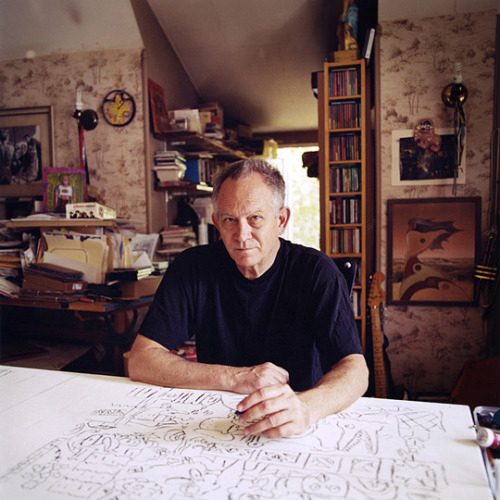
This is great: ten drawing tips from Gary Panter, including such gems as:

This is great: ten drawing tips from Gary Panter, including such gems as:
Most people (even your favorite artists) don’t like their drawings as much as they want to. Why? Because it is easy to imagine something better. This is only ambition, which is not a bad thing — but if you can accept what you are doing, of course you will progress quicker to a more satisfying level and also accidentally make perfectly charming drawings even if they embarrass you.And:
Don’t worry about a style. It will creep up on you and eventually you will have to undo it in order to go further. Be like a river and accept everything.
2 oct 2012
Howard Lyon: Color Theory
Howard Lyon: Color Theory:
Our good friend, and really talented artist, Howard Lyon just posted a wonderful article on color theory on his blog.
Titled 'Building Harmonious Color', Howard breaks down for his readers how to achieve a a cohesive color 'scheme' for a painting in very simple, easy-to-understand terms.
If you have trouble using a limited palette, or difficulty achieving 'mood' in your pieces, this is a really good read. You can check it out: HERE
Our good friend, and really talented artist, Howard Lyon just posted a wonderful article on color theory on his blog.
Titled 'Building Harmonious Color', Howard breaks down for his readers how to achieve a a cohesive color 'scheme' for a painting in very simple, easy-to-understand terms.
If you have trouble using a limited palette, or difficulty achieving 'mood' in your pieces, this is a really good read. You can check it out: HERE
18 sept 2012
reretlet: agenerousdesigner: Calvin and Hobbes: the mood for...
reretlet:
agenerousdesigner:
Calvin and Hobbes: the mood for...:
reretlet:
agenerousdesigner:
Calvin and Hobbes: the mood for...:

reretlet:
agenerousdesigner:(via nickelcobalt)
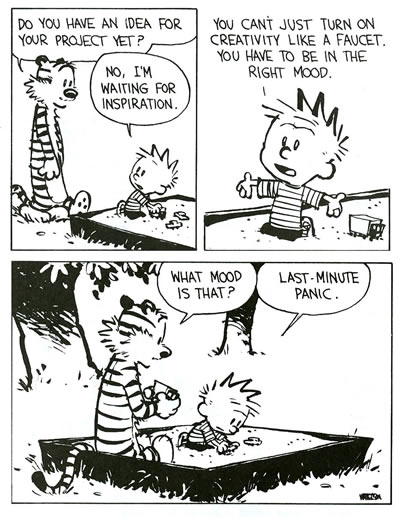
Calvin and Hobbes: the mood for inspiration
(via bigfun: nicolazaro)
13 sept 2012
28 ago 2012
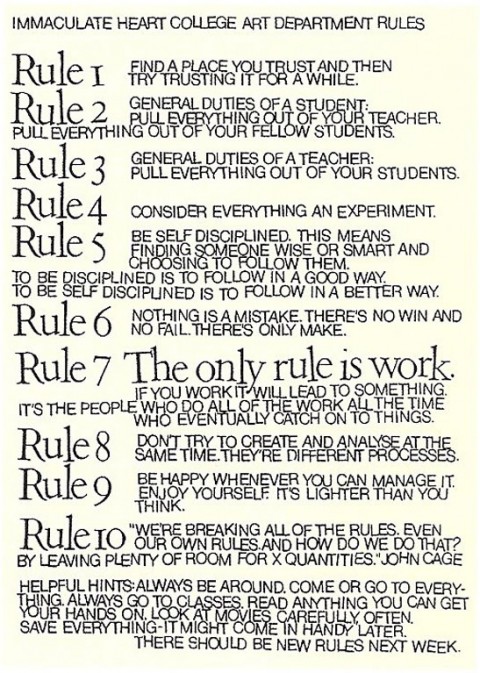
10 Rules for Students
10 Rules for Students:

Some Rules for Students and Teachers, attributed to John Cage, but originates from celebrated artist and educator Sister Corita Kent.

Some Rules for Students and Teachers, attributed to John Cage, but originates from celebrated artist and educator Sister Corita Kent.
24 ago 2012
Another little trick I know 5
Another little trick I know 5:
Toward the end of a painting day it is often useful to know how long you will have to continue painting before the light fails. I love saying "when the light fails" it is so old timey and romantic sounding. Long ago I used to tell One lovely young woman that I would meet her "when the light fails".
Here is a way to tell how long you have before dark, this is an old woodsman's trick. Hold your hand out at arms length. Then place your hand below the sun with the bottom of your hand on the horizon, or that line of trees, or whatever the sun intends to drop behind. You might need to use both hands to do this if the sun is still high. Count how many fingers there are between the sun and the horizon. You can figure on fifteen minutes for each finger. In the picture above I have 45 minutes before the sun drops behind that row of trees.This works no matter how large or how small your hands are, I suppose because the length of your arm varies somewhat in proportion to the size of your hand.
Here is a trick for keeping your white (or whatever color) fresher overnight.
.
Put a tuna fish can upside down over that pile of color and it will be less likely to dry out overnight. If drying paint overnight is a big problem, you can always put your paint in the refrigerator. That won't hurt it at all. You might want to make a special box for it if you do this routinely. That will keep the paint and your cottage cheese separate. In the winter I often throw the palette in the trunk of my car when I am done working for the day. Even if the night is very cold the colors will rapidly warm up again in the heat of my studio.
I have the attention span of a goldfish. A goldfish has about a two second memory. All day they swim around their little bowl muttering "I think I've seen this before... I could swear I've seen this before,
I think I've seen this before". I have a case of ADD that would kill an ordinary man, I am a human whippet, I am so easily distracted.
So, I keep a kitchen timer beside my easel. When I am having a problem staying focused, I work timed hours. I set the timer and no matter what happens I work for an entire hour. If the phone rings I will ignore it. I don't do this all the time but when I am against a deadline or there are lots of distractions I set my timer. Evidently people with jobs have similar systems involving timeclocks and scowling supervisors. To be self employed you have to have the discipline to oversee yourself, no one else will.
Is this next item a painting trick? Maybe not. but it is a useful survival habit for gaunt bohemians and hipsters with uncertain incomes.
Every time I sell a painting I go to the grocery store, there I make a point of buying a selection of imperishable food items, along with my regular grocery purchases. I buy things like tuna fish, soups, spaghetti sauce, noodles. canned soup, you know, stuff that will patiently wait for a long time to be eaten. This has saved me from hunger many times. These days my income is always sufficient to feed me, but there have been times when it was not and I went hungry many times. I still practice this habit out of caution, in these uncertain and tenuous economic times you never know. I could live for a month or longer without buying groceries if I had to. If you belong to Costco or Sams Club, that is a great place to shop for survival rations. I usually have a case of soap around and enough dish detergent and household cleaning products to carry me through an extended period of financial misfortune. I feel safer knowing that I have a well stocked larder, just in case.
I do this with art supplies too. I buy my paint by the quart or five big tubes at a time. I could paint for months without resupplying. Paint won't spoil and I feel comforted knowing that it is there.
---------------------------------------------------------------------------------------------
I have a few spots left in the Minnesota workshop to be held in Stillwater, Sept. 15 through the 17th.
I am excited to be teaching in Minnesota, where I grew up. I like the prairies and hills there. Minnesota has great oak trees that are fun to paint. It is often a low horizon sort of a place, reminiscent of my hero Seago or Dutch painting. Perhaps you would like to join the group? I can save you YEARS of screwing around. Workshops are a lot of fun and I enjoy teaching them. We will also have Kami Polzin as a special guest star for a day, and I am working on having a second guest artist. Each day after painting we go out to dinner and I draw on napkins and teach design skills from my laptop. So this is the most intense a program possible. It runs from breakfast until after a late dinner. You will be exhausted at the end of each day, I promise. I will work you like a borrowed mule!. I only have three days with you and I want to cram as much into that time as I possibly can. There is a lot of camaraderie and I am always sorry when work shops end. Below is the link if you would like to sign up or learn a little more about the work shop.
http://stapletonkearns.blogspot.com/search?q=Minnesota+Workshop+Fall+2012
The same is true of my New Hampshire workshop in the White Mountains. I am down to only a few spaces left so let me know if you would like to come.
This is a total immersion program and I run the class about 12 hours a day. I do an evening lecture while we wait for dinner to be served.The fall color in the White Mountains is legendary and people come from all over the world to see it. In the 19th century all of the great Hudson River painters made a point of being there too, just a few miles up the road from the inn.Sign up here;
http://stapletonkearns.blogspot.com/2012/05/workshops-for-sale.html
Toward the end of a painting day it is often useful to know how long you will have to continue painting before the light fails. I love saying "when the light fails" it is so old timey and romantic sounding. Long ago I used to tell One lovely young woman that I would meet her "when the light fails".
Here is a way to tell how long you have before dark, this is an old woodsman's trick. Hold your hand out at arms length. Then place your hand below the sun with the bottom of your hand on the horizon, or that line of trees, or whatever the sun intends to drop behind. You might need to use both hands to do this if the sun is still high. Count how many fingers there are between the sun and the horizon. You can figure on fifteen minutes for each finger. In the picture above I have 45 minutes before the sun drops behind that row of trees.This works no matter how large or how small your hands are, I suppose because the length of your arm varies somewhat in proportion to the size of your hand.
Here is a trick for keeping your white (or whatever color) fresher overnight.
.
Put a tuna fish can upside down over that pile of color and it will be less likely to dry out overnight. If drying paint overnight is a big problem, you can always put your paint in the refrigerator. That won't hurt it at all. You might want to make a special box for it if you do this routinely. That will keep the paint and your cottage cheese separate. In the winter I often throw the palette in the trunk of my car when I am done working for the day. Even if the night is very cold the colors will rapidly warm up again in the heat of my studio.
I have the attention span of a goldfish. A goldfish has about a two second memory. All day they swim around their little bowl muttering "I think I've seen this before... I could swear I've seen this before,
I think I've seen this before". I have a case of ADD that would kill an ordinary man, I am a human whippet, I am so easily distracted.
So, I keep a kitchen timer beside my easel. When I am having a problem staying focused, I work timed hours. I set the timer and no matter what happens I work for an entire hour. If the phone rings I will ignore it. I don't do this all the time but when I am against a deadline or there are lots of distractions I set my timer. Evidently people with jobs have similar systems involving timeclocks and scowling supervisors. To be self employed you have to have the discipline to oversee yourself, no one else will.
Is this next item a painting trick? Maybe not. but it is a useful survival habit for gaunt bohemians and hipsters with uncertain incomes.
STARVEPROOFING!
Every time I sell a painting I go to the grocery store, there I make a point of buying a selection of imperishable food items, along with my regular grocery purchases. I buy things like tuna fish, soups, spaghetti sauce, noodles. canned soup, you know, stuff that will patiently wait for a long time to be eaten. This has saved me from hunger many times. These days my income is always sufficient to feed me, but there have been times when it was not and I went hungry many times. I still practice this habit out of caution, in these uncertain and tenuous economic times you never know. I could live for a month or longer without buying groceries if I had to. If you belong to Costco or Sams Club, that is a great place to shop for survival rations. I usually have a case of soap around and enough dish detergent and household cleaning products to carry me through an extended period of financial misfortune. I feel safer knowing that I have a well stocked larder, just in case.
I do this with art supplies too. I buy my paint by the quart or five big tubes at a time. I could paint for months without resupplying. Paint won't spoil and I feel comforted knowing that it is there.
---------------------------------------------------------------------------------------------
I have a few spots left in the Minnesota workshop to be held in Stillwater, Sept. 15 through the 17th.
I am excited to be teaching in Minnesota, where I grew up. I like the prairies and hills there. Minnesota has great oak trees that are fun to paint. It is often a low horizon sort of a place, reminiscent of my hero Seago or Dutch painting. Perhaps you would like to join the group? I can save you YEARS of screwing around. Workshops are a lot of fun and I enjoy teaching them. We will also have Kami Polzin as a special guest star for a day, and I am working on having a second guest artist. Each day after painting we go out to dinner and I draw on napkins and teach design skills from my laptop. So this is the most intense a program possible. It runs from breakfast until after a late dinner. You will be exhausted at the end of each day, I promise. I will work you like a borrowed mule!. I only have three days with you and I want to cram as much into that time as I possibly can. There is a lot of camaraderie and I am always sorry when work shops end. Below is the link if you would like to sign up or learn a little more about the work shop.
http://stapletonkearns.blogspot.com/search?q=Minnesota+Workshop+Fall+2012
The same is true of my New Hampshire workshop in the White Mountains. I am down to only a few spaces left so let me know if you would like to come.
This is a total immersion program and I run the class about 12 hours a day. I do an evening lecture while we wait for dinner to be served.The fall color in the White Mountains is legendary and people come from all over the world to see it. In the 19th century all of the great Hudson River painters made a point of being there too, just a few miles up the road from the inn.Sign up here;
http://stapletonkearns.blogspot.com/2012/05/workshops-for-sale.html
22 ago 2012
10 Things...About Planning Pictures
10 Things...About Planning Pictures:
Gregory Manchess
Start small.
Thumbnails. Learn to draw them. Learn to use them. Learn to love them. What you design small will always blow up proportionately. Starting out large will not always work. Use the small size of thumbnails to structure your painting quickly, expediently. You can cover greater ground in a small size. Thumbs will teach you how to draw better, and how to design better.
Don’t think they will? You’ll discover the contrary all too quickly, while others speed beyond you.
Think inside the box.
I always start with a perimeter, a box, to contain my design. There really aren’t any spaces that don’t demand balance, even a vignette. It must always balance. So I design within a rectangle, like a book cover, to get my composition. Design the entire space from side to side, top to bottom, front to back. Everything on the page must be there for a purpose, even if enigmatic and weird, it still must balance.
This is the time when ‘thinking outside the box’ is not appropriate.
Look for a better pov.
I strive to look for a better angle, a better point of view to express my narrative picture. I can’t stand how often artists choose the same design: one figure, smack in the middle of the painting, at noon. I want to get pulled in to a piece, to learn more or to spur my sense of wonder. That’s what makes the viewer linger and think. Search for the interesting points. There’s always too many, so pick a good interesting one.
Research.
If I'm going to paint metal, then I think about how metal looks. Try to feel it. Then I go get some metal to study, or reference of metal to look at. Or flesh. Or water. Or mountains...
What’s so hard about this? No one wants to get the right reference to help themselves. Probably still suffering from thinking we paint from our heads. We don’t. Research your materials.
Lighting decision.
Right off, I decide what time of day or night the picture lives in. Decide if it’s stage lighting or natural light. Overcast day or sunny? Moonlit night, or man-made night light? This is the very first thing I must do to get ahold of my value structure. I can always change, but I start right here with light.
Value control.
Along with lighting, I think about contrasts. How will my figure contrast against the background, or the sky, or the landscape, or interior? Is it dark and moody, or a bright daylight piece? Decide. Early. Then blend and adjust shadows and lighting so that it works as a whole, using light, silhouette, shape, and mood to control your values. I study great black and white art and photography. I watch noir films. Study comics. I live in a b/w world for a while.
Overlap stuff.
When we create characters we want to know all about them so we tend to draw them completely. The same for the next character, and so on. We keep them all separate, so we can see them. But this makes the most boring design ever. Things don’t look like that in life, so avoid it. Elements overlap, always. Things get hidden.
I DESIGN my paintings so that figures overlap. It mimics life and creates tension and depth. Just like we see things.
Clump elements.
Did I mention I overlap figures? Mountains? Trees? Animals? Buildings? Colors? Objects? Yeah, well....when I overlap elements, I design them so that they tell a story in clumps, patterns, groupings. Ya don’t paint every cow leg in a field. Most of them overlap the cow next to them. Same for trees. Same for people. Same for.....
Put them in groups, or clumps, so that it breaks the monotony.
Lead with line.
Don’t go crazy with this. The lines I’m talking about are simple and direct. They lead the eye to the primary viewing spots of a painting, AND THAT’S ALL. They don’t spin the eye, rotate the eye, they don’t mimic repeating shapes, and they never cause the eye to “leave the canvas” or even “reenter the picture.” This is all bunk.
The line I’m talking about is something where a figure or an arm leads your eye to the center of attraction. Other lines help to lead to the same spot. AND THAT’S ALL. (see points on balance above if you have questions about this.)
Foreground, middle ground, background.
That’s what I meant by front to back above. I think of my painting as a stage. Build the stage. Put figures on the stage. Costume the characters. Light the stage. Now pick where the camera (eye) is going to look at that stage.
At this point it has depth. I have to move stage characters around (called blocking) so that I can see them, keep them overlapped, and still tell the story of the picture, which is now a slice of time.
Keep it simple. Am I being obtuse? What’s so hard about this? So many want to reject it. It’s been this way for a couple hundred years. Classic stuff. Gotta learn it before you can modify it.
I know, I know. You can modify things as you learn them, but you’ll always end up returning to these basic principles. Promise.
Gregory Manchess
Start small.
Thumbnails. Learn to draw them. Learn to use them. Learn to love them. What you design small will always blow up proportionately. Starting out large will not always work. Use the small size of thumbnails to structure your painting quickly, expediently. You can cover greater ground in a small size. Thumbs will teach you how to draw better, and how to design better.
Don’t think they will? You’ll discover the contrary all too quickly, while others speed beyond you.
Think inside the box.
I always start with a perimeter, a box, to contain my design. There really aren’t any spaces that don’t demand balance, even a vignette. It must always balance. So I design within a rectangle, like a book cover, to get my composition. Design the entire space from side to side, top to bottom, front to back. Everything on the page must be there for a purpose, even if enigmatic and weird, it still must balance.
This is the time when ‘thinking outside the box’ is not appropriate.
Look for a better pov.
I strive to look for a better angle, a better point of view to express my narrative picture. I can’t stand how often artists choose the same design: one figure, smack in the middle of the painting, at noon. I want to get pulled in to a piece, to learn more or to spur my sense of wonder. That’s what makes the viewer linger and think. Search for the interesting points. There’s always too many, so pick a good interesting one.
Research.
If I'm going to paint metal, then I think about how metal looks. Try to feel it. Then I go get some metal to study, or reference of metal to look at. Or flesh. Or water. Or mountains...
What’s so hard about this? No one wants to get the right reference to help themselves. Probably still suffering from thinking we paint from our heads. We don’t. Research your materials.
Lighting decision.
Right off, I decide what time of day or night the picture lives in. Decide if it’s stage lighting or natural light. Overcast day or sunny? Moonlit night, or man-made night light? This is the very first thing I must do to get ahold of my value structure. I can always change, but I start right here with light.
Value control.
Along with lighting, I think about contrasts. How will my figure contrast against the background, or the sky, or the landscape, or interior? Is it dark and moody, or a bright daylight piece? Decide. Early. Then blend and adjust shadows and lighting so that it works as a whole, using light, silhouette, shape, and mood to control your values. I study great black and white art and photography. I watch noir films. Study comics. I live in a b/w world for a while.
Overlap stuff.
When we create characters we want to know all about them so we tend to draw them completely. The same for the next character, and so on. We keep them all separate, so we can see them. But this makes the most boring design ever. Things don’t look like that in life, so avoid it. Elements overlap, always. Things get hidden.
I DESIGN my paintings so that figures overlap. It mimics life and creates tension and depth. Just like we see things.
Clump elements.
Did I mention I overlap figures? Mountains? Trees? Animals? Buildings? Colors? Objects? Yeah, well....when I overlap elements, I design them so that they tell a story in clumps, patterns, groupings. Ya don’t paint every cow leg in a field. Most of them overlap the cow next to them. Same for trees. Same for people. Same for.....
Put them in groups, or clumps, so that it breaks the monotony.
Lead with line.
Don’t go crazy with this. The lines I’m talking about are simple and direct. They lead the eye to the primary viewing spots of a painting, AND THAT’S ALL. They don’t spin the eye, rotate the eye, they don’t mimic repeating shapes, and they never cause the eye to “leave the canvas” or even “reenter the picture.” This is all bunk.
The line I’m talking about is something where a figure or an arm leads your eye to the center of attraction. Other lines help to lead to the same spot. AND THAT’S ALL. (see points on balance above if you have questions about this.)
Foreground, middle ground, background.
That’s what I meant by front to back above. I think of my painting as a stage. Build the stage. Put figures on the stage. Costume the characters. Light the stage. Now pick where the camera (eye) is going to look at that stage.
At this point it has depth. I have to move stage characters around (called blocking) so that I can see them, keep them overlapped, and still tell the story of the picture, which is now a slice of time.
Keep it simple. Am I being obtuse? What’s so hard about this? So many want to reject it. It’s been this way for a couple hundred years. Classic stuff. Gotta learn it before you can modify it.
I know, I know. You can modify things as you learn them, but you’ll always end up returning to these basic principles. Promise.
21 ago 2012
Color Schemes
Color Schemes: Though the accomplished author who made fun of me in the comments for using a real word was joking, I thought I ought to do a post on triadic color schemes.
Since James Gurney has already covered this subject in great detail, rather than cover the basics again, I'll just add a few thoughts to the discussion.
Many color schemes work just as well whether you are using the traditional color wheel (ROYGBIV) or the color wheel of light (RBG). While the ROYGBIV wheel stretches the warm end of the spectrum, making the wheel a little more polar in its temperature, red and cyan resonate against each other as complements just as well as, and possibly more strongly than, red and green. Same is true for magenta and green, yellow and blue (which is closer to indigo on most monitors), and so forth.
However, triadic color schemes---images using three equidistant colors from the color wheel---don't act the same in both wheels. This is probably because of the stretching I talked about above.
The advantage to a traditional triadic color scheme is that its even nature comes across in images using it. It's not an exciting color combination, but the even and predictable nature of it makes it comfortable, almost friendly.
A triadic scheme from the RGB spectrum still works fine if you are just looking for interesting color combinations. But for some reason it doesn't achieve the same effect as the ROYGBIV version.
This may not be a surprising discovery to some, but I've noticed that the farther you push a color scheme away from peak saturation and value, the more you lose the strengths of that color scheme. However, the colors still retain a shadow of what they used to be, so even at its extremes a color scheme has a hint of the message that goes along with it.
While a triadic color scheme can feel balanced, safe, and even child-like, which triad you pick for your subject matter can still strongly affect the mood of your image. Look at the difference that happens by shifting just a little in one direction:
See how much more off-putting and aggressive the character appears in the second one?
Don't expect too much from a color scheme, though, because the color scheme is often one of the weakest factors in communicating the emotional tone of an image. If I were to assign a priority to the effectiveness of a design element in establishing the theme, emotion, or message of an image, I'd place the priorities something like this:
(Most effective)
1. Style
2. Subject matter/content (I would include shape language here)
3. Lighting scheme
4. Value/color composition
5. Surfaces/Textures
6. Color scheme
(Least effective)
These all might switch places depending on the image, but the point is, don't count on a color scheme to solve your problems if your drawing, lighting, etc. aren't saying what they're supposed to.
So think of color schemes as modifiers: A friendly color scheme won't fundamentally change how you feel about an image, but it might layer in subtext or cast something unexpected into the tone of an image.
Since James Gurney has already covered this subject in great detail, rather than cover the basics again, I'll just add a few thoughts to the discussion.
However, triadic color schemes---images using three equidistant colors from the color wheel---don't act the same in both wheels. This is probably because of the stretching I talked about above.
The advantage to a traditional triadic color scheme is that its even nature comes across in images using it. It's not an exciting color combination, but the even and predictable nature of it makes it comfortable, almost friendly.
A triadic scheme from the RGB spectrum still works fine if you are just looking for interesting color combinations. But for some reason it doesn't achieve the same effect as the ROYGBIV version.
This may not be a surprising discovery to some, but I've noticed that the farther you push a color scheme away from peak saturation and value, the more you lose the strengths of that color scheme. However, the colors still retain a shadow of what they used to be, so even at its extremes a color scheme has a hint of the message that goes along with it.
While a triadic color scheme can feel balanced, safe, and even child-like, which triad you pick for your subject matter can still strongly affect the mood of your image. Look at the difference that happens by shifting just a little in one direction:
See how much more off-putting and aggressive the character appears in the second one?
Don't expect too much from a color scheme, though, because the color scheme is often one of the weakest factors in communicating the emotional tone of an image. If I were to assign a priority to the effectiveness of a design element in establishing the theme, emotion, or message of an image, I'd place the priorities something like this:
(Most effective)
1. Style
2. Subject matter/content (I would include shape language here)
3. Lighting scheme
4. Value/color composition
5. Surfaces/Textures
6. Color scheme
(Least effective)
These all might switch places depending on the image, but the point is, don't count on a color scheme to solve your problems if your drawing, lighting, etc. aren't saying what they're supposed to.
![]() |
| If anything, the primary colors make him seem even more freaky |
The Most Unappealing Color
The Most Unappealing Color:
I don't know if this reproduction is accurate, but Velázquez uses something close to 448C. It contrasts with the pinks of the face and the red of the hair piece.

Thomas Dewing often used a greenish palette. In "Lady in White," there is no red. The background is slightly gradated. The dress is painted with pale blues and yellows, and the seat cushion tends toward yellow green.

Van Dyck's portrait of Horace Walpole uses large areas resembling Pantone 448C for the background and the book, with adjacent red-browns at close to the same value.
What do you think? Were any of them successful? What is your personal reaction to 448C? Please share your reaction in the poll at left and thoughts in the comments.
Bloomberg report on new packaging and how it was decided upon.
Previously on GurneyJourney: The Mud Debate
Recently the Australian government announced its new rules for making cigarette packaging as unattractive as possible.
Instead of allowing distinctive corporate logos, the packages must use a generic type font called Lucida Sans. They must show photos of the diseases caused by smoking. And every package must be printed in Pantone 448C.
The government hired a research firm to come up with the most unappealing color possible. The company conducted studies with nearly 1000 people to find out what color suggests low quality and lack of appeal. The research firm then recommended a drab greenish-brown hue that is far away from the bold reds and blues that have been used traditionally in cigarette packaging.
Is Pantone 448C truly the most unappealing color? This brings us to a question artists continually face: Is there such a thing as a disgusting color, or is it all a matter of context? Are greenish-brown colors the kiss of death in painting?
I wondered if any great artists used this color successfully.
I don't know if this reproduction is accurate, but Velázquez uses something close to 448C. It contrasts with the pinks of the face and the red of the hair piece.

Thomas Dewing often used a greenish palette. In "Lady in White," there is no red. The background is slightly gradated. The dress is painted with pale blues and yellows, and the seat cushion tends toward yellow green.

Van Dyck's portrait of Horace Walpole uses large areas resembling Pantone 448C for the background and the book, with adjacent red-browns at close to the same value.
What do you think? Were any of them successful? What is your personal reaction to 448C? Please share your reaction in the poll at left and thoughts in the comments.
Bloomberg report on new packaging and how it was decided upon.
Previously on GurneyJourney: The Mud Debate
Composition Basics: Value Structure
Composition Basics: Value Structure:
When constructing my compositions, I tend to think in triatic arrangements of Foreground, Middleground, and Background. In order to heighten the relationship between each of these various depths, I try to restrict each area to a general range of value; favoring either black, white, or grey.
For instance, you can let the background be predominately white tones, the middleground predominantly greys, and the foreground predominantly black tones. Or, you could reverse it.
Of course, any arrangement of these three values will work, and there are a lot of combinations.
By restricting your values in each of these areas you visually reinforce your image's sense of depth, thereby making the silhouettes very easy to read… and that's important! Legibility is essential to a good picture. Muddy value structures hurt the viewer's ability to discern shapes, especially at a small scale. This is why you will see technique employed so often in trading card art. When your piece of art is going to be reproduced at just a few inches tall, high contrast compositions work especially well.
Tryptic value schemes like this are readily apparent in Old Masters works, particularly in the engravings of Gustave Dore. Here are three examples of Dore, each one showcasing a different arrangement of black, white and grey in order to emphasize the difference between foreground, middleground and background.
Howard Pyle, Andrew Loomis, and many other illustrators have implemented a similar method, but instead utilized 4 values: White, Near White, Black and Near Black. In doing so, they eliminated the midtones, which are arguably the weakest values in a composition since they describe neither light or shadow. Either way, their intent is the same... to better separate, or unite, areas of a composition through restricted values.
It really doesn't matter which method you use. Whether you started with 2, 3, 4, or even 5 basic values really becomes moot once the subtleties are added. What does matter is finding a method that makes sense to you.
-By Dan dos Santos
When constructing my compositions, I tend to think in triatic arrangements of Foreground, Middleground, and Background. In order to heighten the relationship between each of these various depths, I try to restrict each area to a general range of value; favoring either black, white, or grey.
For instance, you can let the background be predominately white tones, the middleground predominantly greys, and the foreground predominantly black tones. Or, you could reverse it.
Of course, any arrangement of these three values will work, and there are a lot of combinations.
By restricting your values in each of these areas you visually reinforce your image's sense of depth, thereby making the silhouettes very easy to read… and that's important! Legibility is essential to a good picture. Muddy value structures hurt the viewer's ability to discern shapes, especially at a small scale. This is why you will see technique employed so often in trading card art. When your piece of art is going to be reproduced at just a few inches tall, high contrast compositions work especially well.
Tryptic value schemes like this are readily apparent in Old Masters works, particularly in the engravings of Gustave Dore. Here are three examples of Dore, each one showcasing a different arrangement of black, white and grey in order to emphasize the difference between foreground, middleground and background.
![]() |
| BACKGROUND: WHITE MIDDLEGROUND: GREY FOREGROUND: WHITE |
![]() |
| BACKGROUND: GREY MIDDLEGROUND: BLACK FOREGROUND: WHITE |
| BACKGROUND: BLACK MIDDLEGROUND: WHITE FOREGROUND: GREY |
Howard Pyle, Andrew Loomis, and many other illustrators have implemented a similar method, but instead utilized 4 values: White, Near White, Black and Near Black. In doing so, they eliminated the midtones, which are arguably the weakest values in a composition since they describe neither light or shadow. Either way, their intent is the same... to better separate, or unite, areas of a composition through restricted values.
It really doesn't matter which method you use. Whether you started with 2, 3, 4, or even 5 basic values really becomes moot once the subtleties are added. What does matter is finding a method that makes sense to you.
Suscribirse a:
Entradas (Atom)